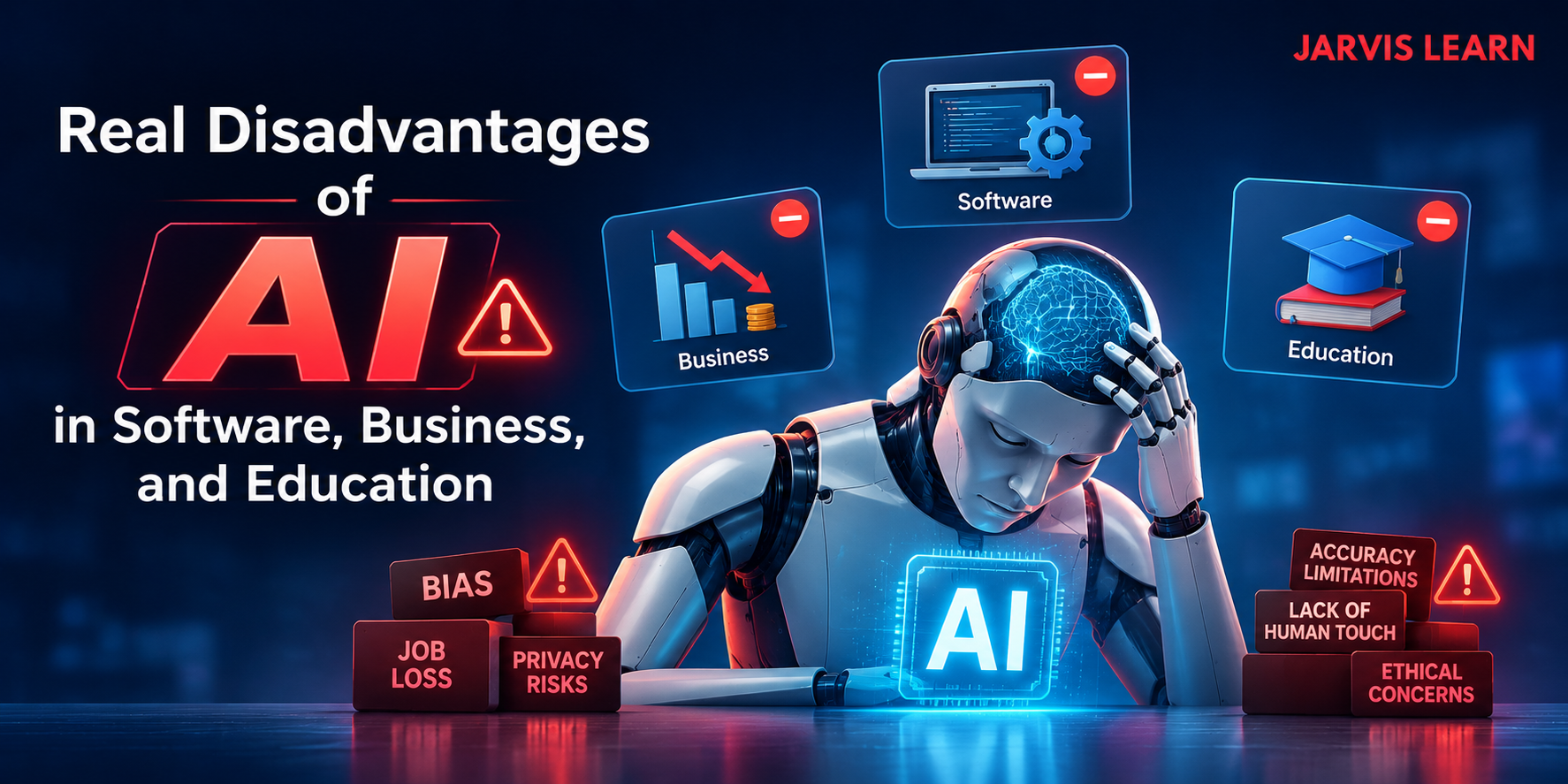
Real Disadvantages of AI in Software, Business, and Education
Thu, 27 August 2026
Inspirational journeys
Follow the stories of academics and their research expeditions
I know a lot of people would not agree to even discuss the disadvantages of AI. I would say this is my hot take. But let's get the debate running. Using AI in everyday life does surely make life easy, but don't you think it happens only with the right use of it?
I have seen it when I train my interns. I always want them to first write with their own understanding of a concept so that I can add my knowledge to theirs. But all they do is open their favorite AI tool, directly paste all the discussions we have in the meeting, and ask the AI to tell them what to do.
Obviously, it would return them with a rejection because I want them to learn but keep relying on AI for such small things. The primary disadvantage of artificial intelligence is the blind spots of non-deterministic outputs.
What I mean by this is, when I give my interns a task, they know which website they are working for. But when they explain AI for what they want, it takes a randomized, rational decision. It's not AI's fault.
Artificial intelligence is meant to work that way, to be rational. But it's the internet's fault because they failed to explain it with the right context. To put it in just a few words, AI can't personalize the response for your prompts because its intelligence is artificial.
That’s my reality. I’m Sushmith. Now building technical training and e-learning programs here at Jarvislearn, I’ve seen every side of the hype cycle. We spend our days creating certification materials that actually prepare developers for the real world.
And the real world isn't as similar as the demo you find of a chatbot that magically does your job. It’s more complex. I am writing this blog based on every disadvantage I faced in my experience.
If you need the quick facts on the demerits of AI, here is the executive summary:
Management usually sees an AI demo and immediately calculates how many salaries they can cut. The reality on the engineering floor is entirely different. The disadvantages of AI in business are rarely about what the model can't do; they are about what it costs to keep the model doing it reliably.
Traditional software engineering is deterministic. You write a function. It takes input A and returns output B. You can write unit tests for this, and you can sleep at night knowing that tomorrow, A will still equal B.
LLMs (Large Language Models) and generative systems are probabilistic. You give them input A, and they might give you B today, B-minus tomorrow, and a bizarre string of formatted JSON pretending to be a French recipe on Thursday. This is one of the most frustrating disadvantages of using AI in production.
When you build a business application on top of an API like OpenAI or Anthropic, you are building a house on shifting sand. We try to wrangle this with prompt engineering and strict temperature settings, but it’s a band-aid.
You end up writing hundreds of lines of validation code just to parse the output of an AI call. Why? Because you have to ensure it didn't randomly decide to output Markdown when you strictly asked for a boolean.
People love searching for the benefits and disadvantages of AI, but they rarely look at the AWS bill. Running a local open-source model requires serious GPU hardware. Using an API means you pay per token. When you integrate AI into a core business workflow, those tokens stack up fast.
Let's look at a simple customer service bot that processes 10,000 queries a day. The hidden costs are staggering:
You aren't saving money. You are just moving the payroll from customer support reps to senior data engineers and cloud providers.
Let’s take this a step further into regulated spaces. We get asked constantly to discuss the advantages and disadvantages of artificial intelligence in fintech. The friction here isn't just about compute costs; it's about auditability.
The disadvantages of artificial intelligence in banking are terrifying when you realize that models cannot explain their math:
This extends into corporate ledgers. When you look at the disadvantages of AI in accounting, the core issue is that precision is literally the law. You cannot have a probabilistic model reconciling a balance sheet.
The brutal truth about the disadvantages of artificial intelligence in accounting is that a 99curacy rate still means the IRS audits your client and someone goes to court. Models guess, but accountants verify. Replacing the latter with the former is organizational suicide.
There is a massive misconception about the disadvantages of AI in the workplace. The fear is job replacement. The reality is job degradation.
When you force an engineering team to rely on AI-generated code, you don't speed up development. You shift the burden from writing code to reviewing code. And reviewing code is mentally exhausting.
Here is why senior developers are burning out:
Their jobs have devolved into babysitting AI-generated pull requests.
At Jarvislearn, education is our entire world. We build training programs. We care deeply about how people learn complex technical skills, and this is where I get genuinely concerned. The disadvantages of artificial intelligence in education are profound, and they strike at the core of human cognitive development.
Learning requires friction. When you are learning to write a Python script, the frustration of a syntax error and the hour you spend digging through Stack Overflow is where the actual learning happens. You are building neural pathways, and you are learning how to debug.
If an AI just spits out the correct script, you bypass the friction. The primary disadvantage of AI in education is that it steals the struggle from the student.
We are breeding a generation of "prompters" who can generate a React component but have absolutely zero idea how the underlying Virtual DOM works. When that component breaks in production, they are helpless.
We also see institutions trying to automate grading. Evaluating the advantages and disadvantages of artificial intelligence in education requires looking closely at evaluation metrics. Automated grading algorithms are inherently flawed because they look for statistical patterns, not genuine understanding.
The failures I've witnessed are glaring:
If you are writing a report on the disadvantages of artificial intelligence, focus on this thesis: AI evaluates the shape of intelligence, not the substance. Leaning too heavily on AI for student assessment destroys trust. Once students realize a bot is grading them, they start writing to game the algorithm, ruining the entire e-learning ecosystem.
Let’s talk security. The disadvantages of AI in cybersecurity aren't just theoretical; they are keeping DevSecOps teams awake right now.
Five years ago, we worried about sanitizing database inputs to prevent SQL injection. Today, we have to worry about prompt injection. Because LLMs do not separate instructions from data, the attack vector is wide open.
A malicious actor can easily exploit this:
Trying to patch this is a nightmare. (If you want a deeper dive into mitigating this, check out the external NIST AI Risk Management Framework). You can put filters in front of the model, but attackers just get more creative.
We train models on massive datasets scraped from the internet. Attackers know this, and they are actively buying expired domains to populate them with subtly manipulated technical documentation.
The supply chain attack works like this:
This opens a backdoor for the attacker. The cons of artificial intelligence in security environments are terrifying because the attack surface is completely opaque. You can't just audit the code.
The disadvantages of AI in security go way beyond code injection. Look at the proliferation of generated media. The disadvantages of artificial intelligence images aren't just about copyright infringement—they are fundamentally breaking identity verification.
When anyone can clone a CEO's voice and generate a live video feed for a Zoom call to authorize a wire transfer, our entire trust model collapses. And if you want to look at the absolute extreme edge of these failures, look at the defense sector.
The disadvantages of AI in the military involve deploying these same probabilistic, easily spoofed models into life-or-death decision loops. An autonomous drone failing to distinguish between a civilian vehicle and a military transport because of a slight glare on the camera lens is a catastrophic structural failure. It is not a bug to be patched in the next sprint.
It’s easy to talk about AI in a clean, temperature-controlled server room. But what happens when you take it outside?
Consider the disadvantages of artificial intelligence in agriculture. Ag-tech startups love pitching AI-driven computer vision systems attached to tractors that can individually identify and spray weeds. It looks amazing on a pitch deck.
In reality, a tractor operates in mud, dust, and rain. A camera lens gets a smudge of dirt on it, the computer vision confidence score drops to zero, and the tractor stops in the middle of the field.
Furthermore, these systems rely on edge computing or continuous cellular connectivity. If you are farming 5,000 acres in rural Nebraska, your 5G connection is going to drop.
When the cloud disconnects, your half-million-dollar AI tractor becomes a very heavy, very dumb piece of metal.
But let's look at higher stakes. The disadvantages of artificial intelligence in transportation are playing out in real-time on our highways. We were promised full self-driving a decade ago.
What we got was cars that occasionally brake for shadows or fail to recognize emergency vehicles. You can't beta-test a two-ton vehicle moving at 70 miles per hour on public roads.
It gets even darker in medicine. The disadvantages of machine learning in healthcare usually stem from biased training data. If you train a diagnostic model primarily on data from a specific demographic, it fails silently when diagnosing patients outside that demographic.
A junior doctor might spot a rare symptom in a marginalized patient. An over-confident AI will just output a generic diagnosis with a 98% confidence score. The exhausted physician might just click "approve," leading to automated malpractice.
We see a lighter version of this with the disadvantages of AI in daily life. Think about smart homes. We’ve all been trapped in the infinite loop of a customer service chatbot that refuses to connect you to a human.
When the centralized API goes down, you literally cannot turn on your living room lights. We are trading resilience for minor conveniences.
You can't weigh the advantages and disadvantages of artificial intelligence without acknowledging why we are using it in the first place. The advantages are obvious. It clears out boilerplate.
If I need a standard regex pattern to parse an email, I don't want to write it from scratch. I’ll ask an LLM. It's fantastic for data transformation and accelerating initial drafting phases.
But the balance of pros and cons heavily shifts when you move from prototyping to production.
Let’s isolate the specific demerits that engineers and project managers have to deal with daily:
If we step back and look at the broader impacts of artificial intelligence in academic contexts, the most glaring issue is the homogenization of thought.
When everyone uses the same three language models to write emails, draft reports, and write code, everything starts to look exactly the same. We lose the weird, human quirks that drive actual innovation.
The benefits and disadvantages of AI are often debated in terms of efficiency, but we rarely talk about the loss of originality.
AI averages out human intelligence. It pulls the bottom up, making terrible writers mediocre. But it pulls the top down, making brilliant, unique thinkers sound like sterile corporate PR bots.
This inevitably leads us to the massive, uncomfortable conversation around AI ethics. Who decides the guardrails? The companies building the models. That is a massive conflict of interest.
The true disadvantages of artificial intelligence on humans aren't about robots taking over; it's about cognitive atrophy. We are offloading our critical thinking to APIs.
When you ask a university class to discuss the advantages and disadvantages of artificial intelligence, and half of them use ChatGPT to write the prompt, we are witnessing the silent collapse of analytical reasoning.
That is the ultimate disadvantage of AI technology—it makes us mentally lazy under the guise of making us productive. The disadvantages of using AI are cultural as much as they are technical.
We are outsourcing our thinking, and as an educator at Jarvislearn, that is the one thing I know we cannot afford to lose.
I’m not a luddite. I write code every day, and I use AI tools when they make sense. But treating AI as a magic bullet is a fast track to technical bankruptcy.
Understanding the disadvantages of artificial intelligence—truly grasping the benefits and drawbacks of AI at a granular, technical level—is what separates a junior developer from a senior engineer. It’s what separates a reactive company from a resilient one.
When we design training programs—like our internal advanced engineering and DevSecOps modules here at Jarvislearn—we don't just teach people how to use a tool. We teach them how the tool breaks.
If you don't know the cons of artificial intelligence, you won't know how to fix your systems when the bots inevitably hallucinate, the APIs time out, and the bill comes due. Stop reading the hype. Start looking at the error logs. That’s where the real education begins.
What are the main negative impacts of AI on human workers?
The biggest impact isn't just job loss—it's cognitive degradation and job shift. Engineers and knowledge workers are pushed from active creators to passive reviewers, babysitting AI outputs. This destroys the "productive struggle" necessary to build real technical skills.
What are the business risks of artificial intelligence?
The primary risks include unpredictable cloud compute costs, the nightmare of managing non-deterministic outputs in production, and massive compliance blind spots. If a probabilistic AI model hallucinates a financial or medical decision, the business holds the full legal liability.
Is AI a security risk?
Absolutely. LLMs introduce entirely new, opaque attack vectors. Techniques like prompt injection allow attackers to hijack AI assistants, while data poisoning lets malicious actors bake vulnerabilities directly into open-source training sets.
Why is AI bad for regulated industries like accounting or healthcare?
AI models cannot confidently explain their math; they are statistical guessing machines. In fields where precision is legally mandated—like reconciling a balance sheet or diagnosing a patient—a 99curacy rate is unacceptable and creates massive legal exposure.
Thu, 27 August 2026
Fri, 26 June 2026
Fri, 24 April 2026

Fri, 09 October 2026



© 2026 JarvisLearn Inc. - All Rights Reserved.